
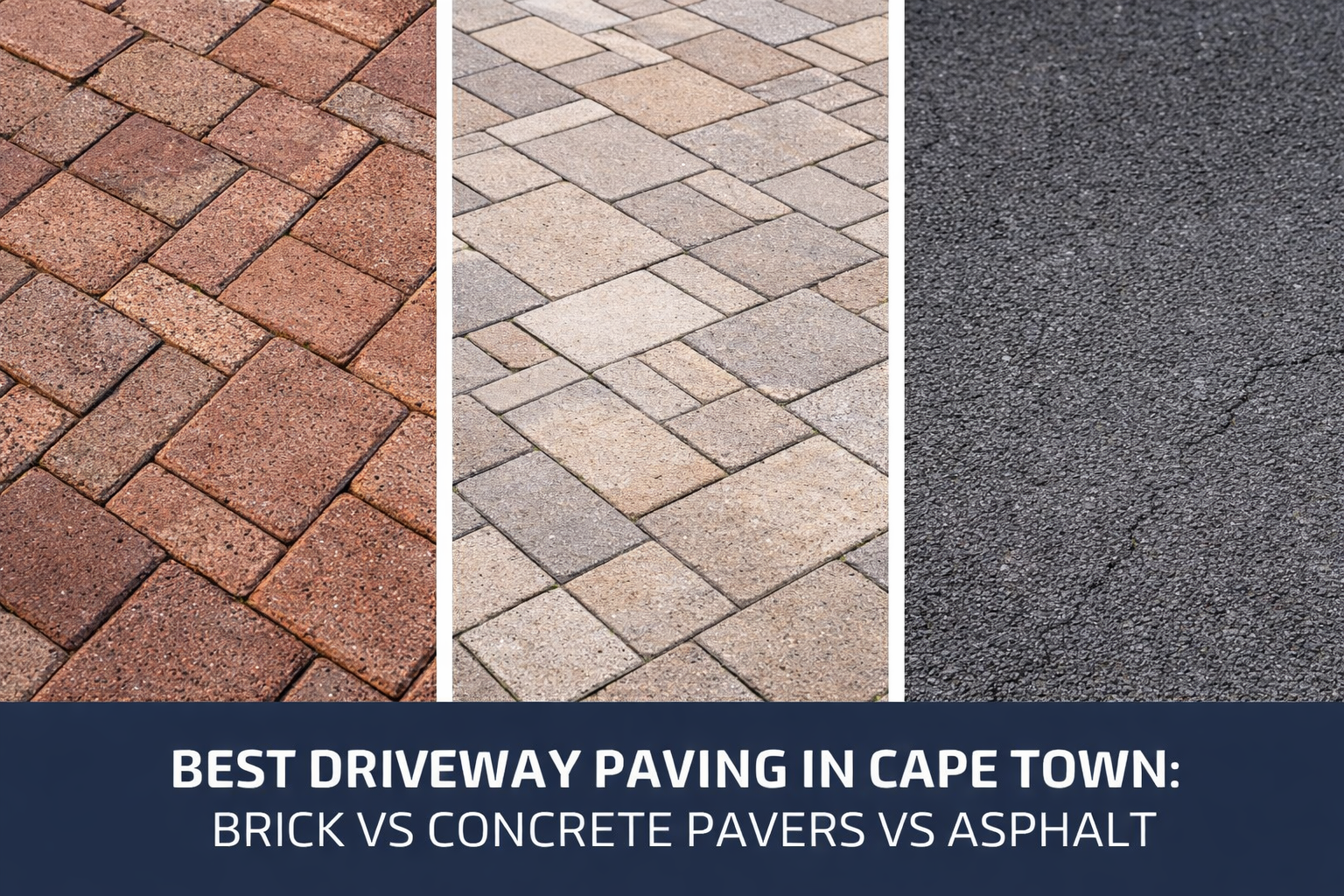
If you live in Cape Town, your driveway gets tested in a very specific way. In summer it bakes, in winter it gets hammered by rain, and all year round you deal with wind-blown sand, dust, and the occasional “let me just turn the wheels while the car isn’t moving” tyre scrub that slowly wrecks weak surfaces.
So when people ask, “What’s best — brick paving, concrete pavers, or asphalt?” the honest answer is: it depends on what you value most, but for most Cape Town homes, pavers win because they’re durable, look great, and they’re repairable in sections when something shifts.
The mistake people make is choosing a surface based only on what looks nice in a photo. A driveway is a working surface. It needs to carry load, handle turning pressure, drain properly, and still look good after a few winters.
Here’s a practical breakdown to help you choose confidently.
The quick “just tell me what to choose” answer
-
If you want the best all-round option for most Cape Town homes: concrete pavers (great look + strong performance + easy repairs).
-
If you want a more classic, premium feel that ages beautifully: brick paving (clay pavers).
-
If you want a smooth continuous surface for a big area and you’re okay with maintenance over time: asphalt.
And whichever paver you choose, the pattern matters for driveways. Herringbone is widely recommended for vehicle areas because it interlocks and distributes load better than patterns with long straight joints.
Get a Paving Recommendation + Quote
Not sure which surface is best? Send your details and we’ll guide you with a practical recommendation and next steps.
First, a Cape Town reality check: what ruins driveways here?
Before comparing materials, it helps to understand what typically causes driveway problems locally:
Cape Town’s winter rainfall and runoff can create pooling water if levels aren’t right, and that can weaken paved areas over time.
Then there’s the sand and fine dust that blows into joints (especially in windier suburbs). If paving is installed with weak edge restraint, that fine movement plus turning tyres can slowly push pavers outward. The result is what you’ve probably seen before: edges spreading, joints opening up, and sections dipping.
So when you choose a driveway surface, you’re really choosing two things:
-
the surface material you’ll see every day, and
-
the installation method underneath it (base prep + compaction + levels + edging), which decides whether it stays neat.
Option 1: Brick paving (clay pavers)
Why people love it
Brick paving has a warm, classic look that suits a lot of Cape Town homes — old or new. It also tends to “age nicely.” Even after years, it still looks like a deliberate design choice rather than a tired surface.
Where brick is strongest
Brick is a strong option when you want a driveway that feels premium and you want something that you can maintain and repair without drama. If a section sinks because of a drain issue or a soft spot underneath, you don’t have to rip out the entire driveway — you can fix the affected section properly (lift, correct, and relay) and the driveway stays consistent. That “repairable in sections” advantage is one of the big reasons segmented paving remains popular.
What to watch out for
Brick paving is only as good as the base and edges. If the base isn’t compacted properly, you’ll see movement. If edge restraint is weak, you’ll see spreading at the sides, especially where cars turn or enter at angles.
The other thing people worry about is weeds. In reality, weeds are usually a maintenance/jointing issue rather than a “brick problem.” If joints are properly filled and maintained, weeds are manageable.
Option 2: Concrete pavers
Why concrete pavers are the “best all-rounder”
Concrete pavers give you the most flexibility. You can go modern and clean, you can go more natural textured, and you can match your driveway to patios and pathways so the entire exterior feels intentional.
For most homeowners, concrete pavers are the sweet spot between looks, durability, and budget. They also share the same big advantage as brick: if something moves later, you can repair in sections instead of replacing everything.
Where concrete pavers shine in Cape Town
-
They work well for driveways with daily use (multiple vehicles, regular turning).
-
They’re easy to “design around” if you have planters, steps, or a slope.
-
You can choose finishes that suit wet conditions and reduce slipping.
What to watch out for
Not all concrete pavers are the same. Cheaper pavers can weather faster, and colour can fade over time depending on quality and exposure. If you’re in a very sunny spot with zero shade all day, this is worth considering.
Also, just like brick: the base matters more than the paver. A high-end paver on a poor base still fails.
Option 3: Asphalt (tar)
When asphalt is a great choice
Asphalt gives you a smooth, continuous surface. If you have a very large driveway area, or you want a clean “simple” look with minimal joint lines, asphalt can make sense.
It’s also practical when you want quick installation and a surface that’s comfortable to walk on barefoot (pavers can heat up too, depending on colour and sun).
The trade-off: maintenance and visible repairs
Asphalt is not “set and forget.” Over time, asphalt surfaces can oxidise and develop cracking, and water ingress accelerates deterioration — which is why asphalt maintenance products and crack sealing/rejuvenation exist in the first place.
And if a section fails, repairs are often visible. A patched tar driveway tends to look like… a patch.
Where asphalt struggles for many Cape Town homes
If the driveway has drainage issues, heavy turning pressure in one area, or tree roots nearby, asphalt can show stress sooner. It can still be a good option — it just needs a realistic maintenance mindset.
Get a Paving Recommendation + Quote
Not sure which surface is best? Send your details and we’ll guide you with a practical recommendation and next steps.
The real deal-breaker: turning pressure and paving patterns
A driveway isn’t only “load” from above — it’s also twisting forces when you turn your wheels. That’s why pattern choice matters so much for pavers.
For vehicle areas, guidance commonly favours herringbone because it interlocks and spreads load in multiple directions better than patterns with long continuous joints.
If you want a driveway that stays tight and doesn’t start creeping at the edges, this detail makes a bigger difference than most people realise.
Drainage is not optional in Cape Town
Whether you choose brick, concrete pavers, or asphalt, a driveway that holds puddles will age badly.
Cape Town winters expose poor levels quickly, and pooling water can weaken paved areas over time.
This is one reason pavers often do well: water can move through joints and escape more easily than on a fully sealed surface, and if a section ever shifts, it can be lifted and corrected.
The goal is simple: water must flow away from the house and away from the garage, and it shouldn’t sit where you walk.
So… which one should you choose?
Here’s the most practical way to decide:
Choose concrete pavers if…
You want a modern premium look, a strong driveway, and the flexibility to match patios and walkways. You also want the option to repair sections later without replacing everything.
Choose brick paving if…
You love the classic look and you want a driveway that feels timeless and “high-end” in a traditional way — and you’re happy to invest in proper groundwork so it stays perfect.
Choose asphalt if…
You want a smooth continuous surface for a larger area and you’re comfortable with ongoing maintenance over time (and potentially visible patch repairs if needed).
What we recommend at Premium Paving (Cape Town)
For most Cape Town residential driveways, we recommend brick or concrete pavers laid in a herringbone pattern, with proper base preparation, correct falls for drainage, and strong edge restraint. That combination gives you the best balance of:
-
long-term durability,
-
a premium look, and
-
practical repairability if something ever shifts.
It’s not the “sexiest” answer — but it’s the one that keeps your driveway looking neat five years from now, not just on day one.
Get a Paving Recommendation + Quote
Not sure which surface is best? Send your details and we’ll guide you with a practical recommendation and next steps.